Finally, a sunny day! I was about to move to Australia.
Service Learning
Based on goals and principles:
- to construct a sense of civic responsibility in students
~ emphasize duty rather than ambiguous "charity"
- to give students hands-on, subject-related experience in the world as part of an education
~ Peter Block's theory of education relates to experience of teaching middle school debate
- to build good relations with the community and successfully respond to a significant community need
-paraphrased from Communication as Critical Inquiry in Service-Learning, by Spoma Jovanovic (2003).
In order to construct civic responsibility,
- encourage independence
~ make students take the initiative - it's beneficial if the student can provide own
transportation, resources, ideas, etc.
- encourage original theory
~ having students do theory will ensure their most thorough understanding of the class topics, as well as the political philosophy of civic service
~ students can apply real-world experiences as a form of research (keeping in mind the dangers of anecdotal evidence in some instances)
Mundane work:
- alone, not legitimate
- in conjunction with other activity (and continuing to meet other criteria), this is legitimate
~ mundane work is after all part of the "real world"
~ can accomplish all of our goals
- Example: letter data entry
Acknowledge overlap of personal and political:
- Allow students to advocate a political perspective with their research
~ ensure that community need is still met, regardless
- Encourage political discourse (or political philosophy) as part of class discussion
and reflection
Showing posts with label RCAH 292. Show all posts
Showing posts with label RCAH 292. Show all posts
27 November 2007

06 November 2007
Bubbles (RCAH 292)
Now Serving Sad Face
The immediate concern I have with John Eger's theory of creativity and economy is its unwarranted optimism. The idea that humanity is naturally progressing to a new era of prosperity and creativity, and that the United States' massive job losses due to outsourcing can be saved by Silicon Valley, seems to be evoking the blind and historically embarrassing predictions of the enlightenment. It was once popular to assert that the industrial revolution would eventually lead to a utopian world, where automation and mass production would provide enough for everyone. We've certainly seen, particularly after World War Two, that there is no magic pill for the timeless ills of society (especially poverty), with which we can passively sit back and watch things fix themselves. The best and most significant contribution to any solution is active, human effort to pursue not only prosperity, but also justice.
Admittedly, this isn't a fair evaluation of Eger's entire piece. He does argue that cities who want to compete in the new internet-economy will have to invest in educating its citizens about the internet, as well as stimulate creativity and civic pride. I couldn't agree with him more, and the abundance of data he provides makes for strong evidence. But he fails to address the very real roadblocks that exist, other than the obvious commonly-entrenched opinion that the arts have no value. Nowhere in his article does he consider the raging debate over who will provide internet service in the United States, and how that service will be provided. Many cities that have attempted to provide free municipal wireless internet have met stiff and pervasive resistance from telecomm giants, who obviously have an interest in keeping the internet private. One such case is the city of Philadelphia, and the result was that "the governor of Pennsylvania last week signed into law a controversial bill that includes, among myriad items, a provision giving incumbent carriers the ability to prevent cities from creating and charging for municipal Wi-Fi networks." The bill was strongly advocated-for by Verizon, who agreed to allow the city of Philadelphia's municipal Wi-Fi to move forward in exchange. The result was that the rest of the state was doomed to remain under the heel of privately-controlled internet.
And the term "privately-controlled internet" takes on another meaning altogether when we consider the fading of net neutrality (which I'm not going to waste space explaining; if you don't know about it yet, that really is your problem and you should go here immediately). With the FTC more or less controlled by telecomm giants ("I . . . question the starting assumption that government regulation, rather than the market itself under existing laws, will provide the best solution to a problem," says FTC Chair Deborah Platt Majoras, utilizing the terminology of Comcast, AT&T and Verizon), net neutrality is not being enforced. ISPs are already moving on that information, with Comcast blocking bittorrent traffic (much of which is wholly legal, such as an employer distributing information to employees, or software developers distributing patches to their customers).
None of this is mentioned by John Eger; his article was so dearth of anything regarding net neutrality that it almost seems I've gone off-course in evaluating it. But I haven't, because if telecomm giants can control what consumers access on the internet, there can be none of Eger's creativity. All the excitement over user-created content, the sort of "internet populism" that fuels optimistic arguments such as Eger's, fails to recognize that without net neutrality, the internet will slowly grow more like television, with content regulated by the gate-keepers at large media corporations. And to the extent that the internet is influenced by the United States, this will have repercussions around the globe.
The immediate concern I have with John Eger's theory of creativity and economy is its unwarranted optimism. The idea that humanity is naturally progressing to a new era of prosperity and creativity, and that the United States' massive job losses due to outsourcing can be saved by Silicon Valley, seems to be evoking the blind and historically embarrassing predictions of the enlightenment. It was once popular to assert that the industrial revolution would eventually lead to a utopian world, where automation and mass production would provide enough for everyone. We've certainly seen, particularly after World War Two, that there is no magic pill for the timeless ills of society (especially poverty), with which we can passively sit back and watch things fix themselves. The best and most significant contribution to any solution is active, human effort to pursue not only prosperity, but also justice.
Admittedly, this isn't a fair evaluation of Eger's entire piece. He does argue that cities who want to compete in the new internet-economy will have to invest in educating its citizens about the internet, as well as stimulate creativity and civic pride. I couldn't agree with him more, and the abundance of data he provides makes for strong evidence. But he fails to address the very real roadblocks that exist, other than the obvious commonly-entrenched opinion that the arts have no value. Nowhere in his article does he consider the raging debate over who will provide internet service in the United States, and how that service will be provided. Many cities that have attempted to provide free municipal wireless internet have met stiff and pervasive resistance from telecomm giants, who obviously have an interest in keeping the internet private. One such case is the city of Philadelphia, and the result was that "the governor of Pennsylvania last week signed into law a controversial bill that includes, among myriad items, a provision giving incumbent carriers the ability to prevent cities from creating and charging for municipal Wi-Fi networks." The bill was strongly advocated-for by Verizon, who agreed to allow the city of Philadelphia's municipal Wi-Fi to move forward in exchange. The result was that the rest of the state was doomed to remain under the heel of privately-controlled internet.
And the term "privately-controlled internet" takes on another meaning altogether when we consider the fading of net neutrality (which I'm not going to waste space explaining; if you don't know about it yet, that really is your problem and you should go here immediately). With the FTC more or less controlled by telecomm giants ("I . . . question the starting assumption that government regulation, rather than the market itself under existing laws, will provide the best solution to a problem," says FTC Chair Deborah Platt Majoras, utilizing the terminology of Comcast, AT&T and Verizon), net neutrality is not being enforced. ISPs are already moving on that information, with Comcast blocking bittorrent traffic (much of which is wholly legal, such as an employer distributing information to employees, or software developers distributing patches to their customers).
None of this is mentioned by John Eger; his article was so dearth of anything regarding net neutrality that it almost seems I've gone off-course in evaluating it. But I haven't, because if telecomm giants can control what consumers access on the internet, there can be none of Eger's creativity. All the excitement over user-created content, the sort of "internet populism" that fuels optimistic arguments such as Eger's, fails to recognize that without net neutrality, the internet will slowly grow more like television, with content regulated by the gate-keepers at large media corporations. And to the extent that the internet is influenced by the United States, this will have repercussions around the globe.
02 October 2007
RCAH 292/PHL 356 - Instrumentality and Lessons of Feminism
Peter Block's discussion of the instrumental imperative makes the subtle argument ("subtle" if for no other reason than his vague style) that socializing forces in American society have the purpose of molding each person into an instrument. The implications of this argument are far-reaching; nothing could fly in the face of our American self-image more than the idea that we are instruments rather than self-determining individuals.
To sort of take Block's argument for a "test drive," I'd like to look at one of the largest socializing factors in America (and indeed the rest of the world) from his instrumental perspective. While he is concerned with the sorts of jobs we're raising people to fill (his economist/engineer archetypes), there's another element to this instrumentality.
The common understanding of feminism is that it's the cause of womens' equal rights, but what we can learn from feminist philosophy goes a bit further. We quickly learn that women face the socialization of society from the moment they are born - dressed in pink rather than blue, given effeminate toys to play with, receiving messages about what a woman is from her mother and later television, school, and other children. Women today are still given the message that they belong in the private sphere, that they are not intelligent, that they must be a dependent of a husband, and that as a result of this dependency the most important thing for them is to be attractive to men.
Obviously these messages have been diluted and broken up by the feminist movement, but they remain strong and surprisingly prevalent (despite the common misconception to the contrary). This seems to relate somewhat to instrumentality regarding women, but the lessons of feminism are in fact useful for looking at every person. With the two genders viewed in a hierarchy as something of symmetrical opposites, what is "feminine" is often defined as what is "not manly;" it's likewise the case that men are expected to exhibit traits that are "not feminine." If women are emotional and irrational, then to be rational men must suppress their emotions. If women are more inclined towards art or other pursuits of immeasurable, impractical value, then manly pursuits are those which are practical or measurably productive.
That brings us more directly to Block's idea of instrumentality. While the concept does include socialization, we don't see gender socialization helping to form people into instruments until we look at the "reflection of sexism." By suppressing emotions and pursuing what is practical and measurable, men in our society are socialized to be instruments - effective workers who can have technical expertise without thinking too much about impractical, "feminine" concerns (art, philosophy, introspection, etc.) which might distract them from their work (that is to say, lead them to question the status quo, as Block does).
I should, of course, clarify what I mean with "reflection of sexism." By no means is it true that men have faced socialization equivalent to that faced by women; to paraphrase Simone de Beauvoir, the genders are symmetrical only on paper. It's often the case that things considered to be "normal, human" things are relegated to males, whereas females are seen as an inhuman other. This adds further problems to the socialization of men I've outlined above; liberated women in modern times sometimes come to believe that all "manly" traits are "normal" traits for a person to have, and as they adopt those traits themselves, these liberated women are likewise made instruments. They were not raised with the socialization of a man, but all the same, they come to value the suppression of emotion and pursuit of only practical, measurable goals. It might even be said that woman professionals feel the need to prove that they belong in male-dominated worlds of business by exhibiting those super-pragmatic traits.
We're seeing that gender socialization has immense impact, and I would argue that gender socialization is equal to the socializing forces Block identifies in public education as a molder of human instruments. How, in fact, could this impact not be immense? All of humanity is divided into these two genders, and the more difference that we enforce upon them, the more we'll find that our identities are informed by them. Considering the public schools that cut arts or philosophy in favor of math and science, this could even be seen from a feminist perspective: since "manly" traits are seen by many as "normal," our schools' curricula are bound to pursue the creation of people who have those traits. Math and science are indeed valued so highly that the majority of students in some places are in advanced classes; the "normal" classes become the ones that are "slow." (It was like that at my High School.) We rightly encourage girls to learn about math and science, rejecting residual sexist notions that women are incapable in these areas, but in so doing we also continue to push our children towards becoming instruments as per Block's explanation.
I've explained how our misogynistic institutions contribute to the instrumentality of all. How, then, can we help solve the instrumental problem with a feminist solution?
The reality is that what we consider "manly" isn't necessarily "normal," despite what we may think. I suggest that, instead of turning into "men," women in our society should join men in considering that our conceptions of both "manly" and "feminine" are severely flawed. We're not even completely certain that there are only two genders (at birth, babies who seem to have "mixed" genitalia are surgically changed to fit one of the two sexes whose existence we accept). It's not that easy, of course; any decision impacted by one's gender identity will still appear to be a "free choice." But if we can educate ourselves about the nature of gender/sex relations and work to change the socializing forces that separate men and women into predefined categories, we may be able to mitigate or even remove one of the obstacles to "acting on what matters" and living a meaningful life.
To sort of take Block's argument for a "test drive," I'd like to look at one of the largest socializing factors in America (and indeed the rest of the world) from his instrumental perspective. While he is concerned with the sorts of jobs we're raising people to fill (his economist/engineer archetypes), there's another element to this instrumentality.
The common understanding of feminism is that it's the cause of womens' equal rights, but what we can learn from feminist philosophy goes a bit further. We quickly learn that women face the socialization of society from the moment they are born - dressed in pink rather than blue, given effeminate toys to play with, receiving messages about what a woman is from her mother and later television, school, and other children. Women today are still given the message that they belong in the private sphere, that they are not intelligent, that they must be a dependent of a husband, and that as a result of this dependency the most important thing for them is to be attractive to men.
Obviously these messages have been diluted and broken up by the feminist movement, but they remain strong and surprisingly prevalent (despite the common misconception to the contrary). This seems to relate somewhat to instrumentality regarding women, but the lessons of feminism are in fact useful for looking at every person. With the two genders viewed in a hierarchy as something of symmetrical opposites, what is "feminine" is often defined as what is "not manly;" it's likewise the case that men are expected to exhibit traits that are "not feminine." If women are emotional and irrational, then to be rational men must suppress their emotions. If women are more inclined towards art or other pursuits of immeasurable, impractical value, then manly pursuits are those which are practical or measurably productive.
That brings us more directly to Block's idea of instrumentality. While the concept does include socialization, we don't see gender socialization helping to form people into instruments until we look at the "reflection of sexism." By suppressing emotions and pursuing what is practical and measurable, men in our society are socialized to be instruments - effective workers who can have technical expertise without thinking too much about impractical, "feminine" concerns (art, philosophy, introspection, etc.) which might distract them from their work (that is to say, lead them to question the status quo, as Block does).
I should, of course, clarify what I mean with "reflection of sexism." By no means is it true that men have faced socialization equivalent to that faced by women; to paraphrase Simone de Beauvoir, the genders are symmetrical only on paper. It's often the case that things considered to be "normal, human" things are relegated to males, whereas females are seen as an inhuman other. This adds further problems to the socialization of men I've outlined above; liberated women in modern times sometimes come to believe that all "manly" traits are "normal" traits for a person to have, and as they adopt those traits themselves, these liberated women are likewise made instruments. They were not raised with the socialization of a man, but all the same, they come to value the suppression of emotion and pursuit of only practical, measurable goals. It might even be said that woman professionals feel the need to prove that they belong in male-dominated worlds of business by exhibiting those super-pragmatic traits.
We're seeing that gender socialization has immense impact, and I would argue that gender socialization is equal to the socializing forces Block identifies in public education as a molder of human instruments. How, in fact, could this impact not be immense? All of humanity is divided into these two genders, and the more difference that we enforce upon them, the more we'll find that our identities are informed by them. Considering the public schools that cut arts or philosophy in favor of math and science, this could even be seen from a feminist perspective: since "manly" traits are seen by many as "normal," our schools' curricula are bound to pursue the creation of people who have those traits. Math and science are indeed valued so highly that the majority of students in some places are in advanced classes; the "normal" classes become the ones that are "slow." (It was like that at my High School.) We rightly encourage girls to learn about math and science, rejecting residual sexist notions that women are incapable in these areas, but in so doing we also continue to push our children towards becoming instruments as per Block's explanation.
I've explained how our misogynistic institutions contribute to the instrumentality of all. How, then, can we help solve the instrumental problem with a feminist solution?
The reality is that what we consider "manly" isn't necessarily "normal," despite what we may think. I suggest that, instead of turning into "men," women in our society should join men in considering that our conceptions of both "manly" and "feminine" are severely flawed. We're not even completely certain that there are only two genders (at birth, babies who seem to have "mixed" genitalia are surgically changed to fit one of the two sexes whose existence we accept). It's not that easy, of course; any decision impacted by one's gender identity will still appear to be a "free choice." But if we can educate ourselves about the nature of gender/sex relations and work to change the socializing forces that separate men and women into predefined categories, we may be able to mitigate or even remove one of the obstacles to "acting on what matters" and living a meaningful life.
25 September 2007
RCAH 292 - Citizenship
Now Serving caaaafffeeeeeiiinnnnnnee as a disclaimer
The middle class is shifting into reverse.
It's driving itself, wholly backwards, down a highway in Michigan. We see it pass the prosperous Flint of years past, on its way to the Flint of today that begins to grow larger in the rear-view mirror. We see that the driver is facing forwards, gazing down the road, apparently not noticing that the yellow dashes are flitting towards the horizon rather than from it. We are concerned for the safety of the passengers, as driving backwards on the highway is generally thought to be somewhat unsafe, but our concerns are wasted - the middle class rolls in a station wagon built like a tank, and even if it weren't, this Michigan highway on which the middle class drives recently installed a system that doesn't allow cars to stray from the paved path. There is absolute safety and negligible effort.
Getting off the metaphors, it's clear that the American middle class faces a significant list of problems. More and more, members of the middle class are finding themselves not only in debt, but without an understanding of how debt works. We are privy not to knowledge about world events, but rather to infinitely inferior news (which, unlike the objective reality of the world, is more or less artificial). We have a commonly held belief that work is meant to be a suffering experience for which we're compensated by a paycheck. Our apathy regarding world events, finally, translates to an apathy for participation in government. This means that we no longer see ourselves as owners of the government, but rather as subjects.
To put it most dramatically, it seems to me that we're slipping very slowly into serfdom. So when I read Peter Block's argument that we should "define ourselves as citizens," I saw a connection.
In theory, all the citizens of our Republic are joint and equal owners of the government. (If you've ever wondered why "public" sometimes seems to be synonymous with "government," that would be why.) It's no secret that this isn't the case in reality, but if we hold ourselves to that ideal, it can have a number of positive results for us. Considering ourselves citizens will familiarize us with the idea that we have a right to influence public policy, as well as the duty to do so. It reminds us that we are equal under the law, and when we see the law applied unequally based on class or race, keeping ourselves grounded in the idea of citizenship allows us to react to that unfairness with outrage, even after we've seen it so many times as to be unsurprised. A citizen demands justice; a serf accepts injustice. Or as Block puts it, a citizen acts on their values; a serf acts on the principle of survival.
Here now is another significant problem regarding the direction of the middle class. We will see if citizenship can help us address it. The world of the middle class is a world of security; our experience of mortal danger is so rare (thanks to our own efforts) that some of us never face it in the entirety of our existence. It follows that we do not expect to face mortal danger personally; it might even be said that we have forgotten our own mortality. Could there be a set of circumstances under which death becomes more terrifying?
Our mortality hasn't forgotten us of course, and while our experience of mortal danger is rare,
our experience of death is not: we are surrounded by stories of frightful disasters or terrorist plots, which each painfully remind us (having forgotten) that we will die. The way in which this fear contributes to our slide into serfdom is obvious; the role of a feudal Lord in his relationship with peasants is that of protection.
Citizenship may be able to help us regarding this by way of its duties. Where the subjects would demand the ruler's protection, the citizens demand this protection of each other. In grounding ourselves in the notion that we are all citizens, we see that the protectors of our country (the President, a significant bureaucracy, and of course the military) are our legal equals; citizens protect citizens. Again, this is obviously only true in theory, but as before, holding ourselves to an ideal enables us to continue striving for it.
The middle class is shifting into reverse.
It's driving itself, wholly backwards, down a highway in Michigan. We see it pass the prosperous Flint of years past, on its way to the Flint of today that begins to grow larger in the rear-view mirror. We see that the driver is facing forwards, gazing down the road, apparently not noticing that the yellow dashes are flitting towards the horizon rather than from it. We are concerned for the safety of the passengers, as driving backwards on the highway is generally thought to be somewhat unsafe, but our concerns are wasted - the middle class rolls in a station wagon built like a tank, and even if it weren't, this Michigan highway on which the middle class drives recently installed a system that doesn't allow cars to stray from the paved path. There is absolute safety and negligible effort.
Getting off the metaphors, it's clear that the American middle class faces a significant list of problems. More and more, members of the middle class are finding themselves not only in debt, but without an understanding of how debt works. We are privy not to knowledge about world events, but rather to infinitely inferior news (which, unlike the objective reality of the world, is more or less artificial). We have a commonly held belief that work is meant to be a suffering experience for which we're compensated by a paycheck. Our apathy regarding world events, finally, translates to an apathy for participation in government. This means that we no longer see ourselves as owners of the government, but rather as subjects.
To put it most dramatically, it seems to me that we're slipping very slowly into serfdom. So when I read Peter Block's argument that we should "define ourselves as citizens," I saw a connection.
In theory, all the citizens of our Republic are joint and equal owners of the government. (If you've ever wondered why "public" sometimes seems to be synonymous with "government," that would be why.) It's no secret that this isn't the case in reality, but if we hold ourselves to that ideal, it can have a number of positive results for us. Considering ourselves citizens will familiarize us with the idea that we have a right to influence public policy, as well as the duty to do so. It reminds us that we are equal under the law, and when we see the law applied unequally based on class or race, keeping ourselves grounded in the idea of citizenship allows us to react to that unfairness with outrage, even after we've seen it so many times as to be unsurprised. A citizen demands justice; a serf accepts injustice. Or as Block puts it, a citizen acts on their values; a serf acts on the principle of survival.
Here now is another significant problem regarding the direction of the middle class. We will see if citizenship can help us address it. The world of the middle class is a world of security; our experience of mortal danger is so rare (thanks to our own efforts) that some of us never face it in the entirety of our existence. It follows that we do not expect to face mortal danger personally; it might even be said that we have forgotten our own mortality. Could there be a set of circumstances under which death becomes more terrifying?
Our mortality hasn't forgotten us of course, and while our experience of mortal danger is rare,
our experience of death is not: we are surrounded by stories of frightful disasters or terrorist plots, which each painfully remind us (having forgotten) that we will die. The way in which this fear contributes to our slide into serfdom is obvious; the role of a feudal Lord in his relationship with peasants is that of protection.
Citizenship may be able to help us regarding this by way of its duties. Where the subjects would demand the ruler's protection, the citizens demand this protection of each other. In grounding ourselves in the notion that we are all citizens, we see that the protectors of our country (the President, a significant bureaucracy, and of course the military) are our legal equals; citizens protect citizens. Again, this is obviously only true in theory, but as before, holding ourselves to an ideal enables us to continue striving for it.
17 September 2007
RCAH 292 - Idealism, Intimacy, and Depth
Continuing to outline the values he feels are undervalued by society, Peter Block identifies three important qualities and their antitheses in The Answer to How is Yes: Idealism, Intimacy, and Depth. What exactly those words mean to Block requires some interpretive work on the part of the reader, as the text continues to set an exemplary standard for speaking ambiguity to power. That's not to say it has no meaning, however.
Initially promoting idealism, Block explains it as the opposite of cynicism*, continuing to argue that we've lost track of what we really value. In prioritizing power (to use my own words), we set everyone up to not only do what is strictly "practical," but to expect the same from others, and this creates a system in which all of our desires are commercialized (not just material desires, but desires for our lives) and our institutions fail due to the presumption of self-interest.
"Practical" can be interpreted a number of ways and, in this context, needs explication. As Block uses the word, "practical" means "what is most effective for increasing my power" (i.e. that which is expedient, has a good payoff, increases my status, is more convenient, etc.). He thereby appears to argue that applying reason is equivalent to being pessimistic, even identifying himself as "unrealistic," as if to say that realism is actually bad.
It seems wiser to me, however, to not throw out practicality or reason off the bat, nor mistake them for pessimism. If we have lost track of our real values in the way Block says (something that I think is true for many people, if not necessarily the majority), then we should reclaim those real values - our idealism; our desire for things as the way they should be - and then set goals based on them, which would be pursued using reason and practicality. What's practical for achieving a goal based on personal values may not be practical in the sense that it increases an individual's power. In other words, we can remain practical while still adhering to the core of Block's quality of idealism.
One sentence in the text struck me as essential to the entire concept: "We are acting on our deficiencies rather than on capacities." This reveals an underlying current of negativity vs. positivity in Block's writing - not in their vernacular sense of "good" and "bad," but more in the sense of affirmation and refutation, with positive referring to what is and negative referring to what is not.
I can't seem to determine whether Block is suggesting that we should abandon negative thought, or merely that we favor it too heavily. Either way, it's uncontroversially true when he says (in not so few words) that our society prioritizes negative thought.
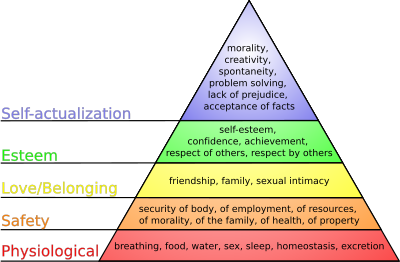
This heavily invokes Maslow's Hierarchy of Needs, a triangular representation of human needs, with the highest priorities being on the bottom. Indeed, nearly all of the physiological needs in Maslow's Hierarchy are negative: breathing, eating, drinking, sleeping, excreting, and maintaining internal stability are all for the sake of not dying. The only positive physiological need hierarchy is the need for sex.
Block's idealism argument could either reject or agree with Maslow's Hierarchy. In rejecting it, Block would simply argue that some or all of the other need categories (self-actualization, esteem, love/belonging, and safety) are as important as physiological needs, and that we've misguidedly suppressed them. In agreeing with the hierarchy, Block's argument could remain potent considering that we expect modern civilization to provide for all our needs, and that at least in the industrialized world, we may be able to give everyone the ability to satisfy the entire hierarchy.
Concerning intimacy, Block's writing becomes the most specific and coherent. Accordingly, I find myself reacting strongly, whether I agree or disagree, to his intimacy-related arguments, and have enjoyed this chapter the most of those I've read so far.
He begins the discussion of intimacy by explaining that he means something specific by it: reclaiming the value of empirical senses, for their own sake. A return to intimacy means a return to aesthetic values and taste - a consideration for and sensitivity to the nuances of sounds, sights, smells, and textures around us. It also means an emphasis on human contact.
It's here that I find the argument problematic. While I agree that human contact is more valuable than society as a whole gives it credit, I don't believe it's entirely appropriate to blame technology for the lack of it, as Block does. Because technology allows us to communicate more expediently, the argument is that it replaces communication that required human contact previously, and this removes too much human contact from our lives.
In "Language Death," David Crystal argues in favor of the preservation of the world's languages. In response to the argument that we could communicate more expediently by sticking to a single lingua franca, he states: "...if one language does, through some process of linguistic evolution, become the world's lingua franca - a status which most people feel is likely to be held by English - it does not follow that this must be at the expense of other languages." Similarly, the use of new technology to facilitate communication merely allows us to spend less time on the communicative logistics of life. I would argue that technology must be used responsibly, and it's our responsibility to ensure that we spend time in physically proximate social settings. If we were to replace these with technological social settings (as Block feels we are doing), it wouldn't be the "fault" of our technology.
Continuing with David Crystal's "Language Death" to counter Block's anti-technological argument: "A world in which everyone speaks at least two languages - their own ethnic language and an international lingua franca - is perfectly possible, and...highly desirable. Because the two languages have different purposes - one for identity, the other for intelligibility - they do not have to be in conflict." It is indeed evident among the generation most comfortable with new communications technology that real social interaction is alive and well. In the dormitories, people regularly visit each other or go out together. Pick-up sports aren't uncommon, and there is definitely plenty of physical contact of all varieties. These are the people who are the most exposed to the communications technology that is supposed to turn us into zombies, and yet it's this exposure that has desensitized them to the novelty of it. Once it's no longer anything out of the ordinary, it's not abused (this becomes something similar to the proverbial argument for removing a taboo, e.g. "familiarity with alcohol will reduce alcohol abuse").
With that said, Block offers compelling examples of technology being abused. The anecdote of the Las Vegas restaurant with what was essentially a bio-dome does strike me as obscene, and the terminator gene is likewise horrible and terrifying (in addition to having the stink of economic injustice, if the likes of Monsanto and Archer Daniels Midland are in control of all new harvests). Relationship-building websites sound very unethical as well, but the nuance with all of these anecdotes is that they're just that, anecdotes. The fact that he uses these to support his argument are proof that his feelings on each anecdote are in the majority (they appeal to common ground), and people who still use technology quite often would agree that these instances constitute abuse.
Block continues to be atypically concise in his criticism of intimacy being used as a marketing strategy. The dangers of reducing such a major element of the human existence to a marketing strategy are obvious, as he points out, even without the immorality of such a deceitful perversion. I would add to his concerns that the reduction of our intimacy to demographics and measurable categories can be seen in mainstream news-media that try to cover a broad amount of material (Time, Newsweek, CNN, Fox, etc.), where it sometimes seems like the entire world is defined within the rules set by media gatekeepers. They practice the oversimplification of news and avoidance of anything that won't be understood or valued by the lowest common denominator of viewers, and I believe this contributes to Block's problem of fading intimacy.
One final interesting note about intimacy is that in talking about it, Block sees the problem as one that did not previously exist. With his other criticisms of the status quo, he seems to be advocating a shift to something never-before-seen; this chapter stands out so far as uniquely advocating the old ways.
Regarding depth, Block argues both that we undervalue introspection and philosophizing, and that we "need to take time to relax." I find the first argument agreeable, with some nuances; the other is a tired cliche that overestimates the problem.
I certainly agree that our culture doesn't place enough value on introspection, amateur philosophy, or intellectualism. I find it absurd that policy advice from Universities, for example, is considered "ivory tower" or "unlrealistic;" this policy advice is coming from the people who have the most knowledge about the topic! We could return to Maslow's Hierarchy and identify these as the least-prioritized human needs that are under "self-actualization," but I would here have to disagree with both Block and the hierarchy: intense introspection and consideration of philosophy isn't something that everyone can benefit from or is inclined to.
I don't merely believe that we've been socialized out of intellectualism (it's considered unattractive for women of all colors to be intellectual, uncool or unachievable for black men, etc.), but also that some people are not intellectual by nature, and philosophy or introspection are not part of their human experience. We should not judge them less-than-human, consider them to be "missing out," or find it problematic that they're not heavy thinkers. With that said, the socialization that discourages intellectualism must certainly stop as Block argues.
The other element of depth discussed in the chapter was that people have come to worship speed, and apply it even in situations when they don't need to. It seems to me that this amounts to a tired argument (no pun intended), that Americans don't relax enough. Where Block is coming from - the white-collar business world - this might certainly be true, but as with some of his other criticisms, he paints with too broad a brush.
There are many parts of America where people are able to lead productive lives while still taking time to slow down and relax, and plenty of people who might relax even a little too much. Just because there are a number of people who take their laptops and cellphones on vacation with them, it doesn't mean everyone or even the majority do. If there were some sort of comprehensive data provided - something that showed we have an extraordinary count of heart attacks or strokes, combined with a high proportion of people with depression, a high average laborer output, etc. - then this would be something to actually address as a problem with society; otherwise, "people need to take time to relax" is really just good advice.
*"optimism" and "cynicism" seem to be words with a wide variety of meanings. In the case of cynycism, the word comes from the name of a movement in Greek philosophy whose proponents tried to "live like dogs," which had little to do with expecting undesirable outcomes or viewing the world as an unpleasant place. (They advocated rejecting the material world and living shamelessly; legend has it Alexander the Great offered their founder Diogenes anything he wanted, and the latter replied "Stop blocking my sunlight, I'm trying to read.") In this text "cynicism" seems to be the belief that everyone will act in their own self-interest, and that there's no other way to live.
Initially promoting idealism, Block explains it as the opposite of cynicism*, continuing to argue that we've lost track of what we really value. In prioritizing power (to use my own words), we set everyone up to not only do what is strictly "practical," but to expect the same from others, and this creates a system in which all of our desires are commercialized (not just material desires, but desires for our lives) and our institutions fail due to the presumption of self-interest.
"Practical" can be interpreted a number of ways and, in this context, needs explication. As Block uses the word, "practical" means "what is most effective for increasing my power" (i.e. that which is expedient, has a good payoff, increases my status, is more convenient, etc.). He thereby appears to argue that applying reason is equivalent to being pessimistic, even identifying himself as "unrealistic," as if to say that realism is actually bad.
It seems wiser to me, however, to not throw out practicality or reason off the bat, nor mistake them for pessimism. If we have lost track of our real values in the way Block says (something that I think is true for many people, if not necessarily the majority), then we should reclaim those real values - our idealism; our desire for things as the way they should be - and then set goals based on them, which would be pursued using reason and practicality. What's practical for achieving a goal based on personal values may not be practical in the sense that it increases an individual's power. In other words, we can remain practical while still adhering to the core of Block's quality of idealism.
One sentence in the text struck me as essential to the entire concept: "We are acting on our deficiencies rather than on capacities." This reveals an underlying current of negativity vs. positivity in Block's writing - not in their vernacular sense of "good" and "bad," but more in the sense of affirmation and refutation, with positive referring to what is and negative referring to what is not.
I can't seem to determine whether Block is suggesting that we should abandon negative thought, or merely that we favor it too heavily. Either way, it's uncontroversially true when he says (in not so few words) that our society prioritizes negative thought.
This heavily invokes Maslow's Hierarchy of Needs, a triangular representation of human needs, with the highest priorities being on the bottom. Indeed, nearly all of the physiological needs in Maslow's Hierarchy are negative: breathing, eating, drinking, sleeping, excreting, and maintaining internal stability are all for the sake of not dying. The only positive physiological need hierarchy is the need for sex.
Block's idealism argument could either reject or agree with Maslow's Hierarchy. In rejecting it, Block would simply argue that some or all of the other need categories (self-actualization, esteem, love/belonging, and safety) are as important as physiological needs, and that we've misguidedly suppressed them. In agreeing with the hierarchy, Block's argument could remain potent considering that we expect modern civilization to provide for all our needs, and that at least in the industrialized world, we may be able to give everyone the ability to satisfy the entire hierarchy.
Concerning intimacy, Block's writing becomes the most specific and coherent. Accordingly, I find myself reacting strongly, whether I agree or disagree, to his intimacy-related arguments, and have enjoyed this chapter the most of those I've read so far.
He begins the discussion of intimacy by explaining that he means something specific by it: reclaiming the value of empirical senses, for their own sake. A return to intimacy means a return to aesthetic values and taste - a consideration for and sensitivity to the nuances of sounds, sights, smells, and textures around us. It also means an emphasis on human contact.
It's here that I find the argument problematic. While I agree that human contact is more valuable than society as a whole gives it credit, I don't believe it's entirely appropriate to blame technology for the lack of it, as Block does. Because technology allows us to communicate more expediently, the argument is that it replaces communication that required human contact previously, and this removes too much human contact from our lives.
In "Language Death," David Crystal argues in favor of the preservation of the world's languages. In response to the argument that we could communicate more expediently by sticking to a single lingua franca, he states: "...if one language does, through some process of linguistic evolution, become the world's lingua franca - a status which most people feel is likely to be held by English - it does not follow that this must be at the expense of other languages." Similarly, the use of new technology to facilitate communication merely allows us to spend less time on the communicative logistics of life. I would argue that technology must be used responsibly, and it's our responsibility to ensure that we spend time in physically proximate social settings. If we were to replace these with technological social settings (as Block feels we are doing), it wouldn't be the "fault" of our technology.
Continuing with David Crystal's "Language Death" to counter Block's anti-technological argument: "A world in which everyone speaks at least two languages - their own ethnic language and an international lingua franca - is perfectly possible, and...highly desirable. Because the two languages have different purposes - one for identity, the other for intelligibility - they do not have to be in conflict." It is indeed evident among the generation most comfortable with new communications technology that real social interaction is alive and well. In the dormitories, people regularly visit each other or go out together. Pick-up sports aren't uncommon, and there is definitely plenty of physical contact of all varieties. These are the people who are the most exposed to the communications technology that is supposed to turn us into zombies, and yet it's this exposure that has desensitized them to the novelty of it. Once it's no longer anything out of the ordinary, it's not abused (this becomes something similar to the proverbial argument for removing a taboo, e.g. "familiarity with alcohol will reduce alcohol abuse").
With that said, Block offers compelling examples of technology being abused. The anecdote of the Las Vegas restaurant with what was essentially a bio-dome does strike me as obscene, and the terminator gene is likewise horrible and terrifying (in addition to having the stink of economic injustice, if the likes of Monsanto and Archer Daniels Midland are in control of all new harvests). Relationship-building websites sound very unethical as well, but the nuance with all of these anecdotes is that they're just that, anecdotes. The fact that he uses these to support his argument are proof that his feelings on each anecdote are in the majority (they appeal to common ground), and people who still use technology quite often would agree that these instances constitute abuse.
Block continues to be atypically concise in his criticism of intimacy being used as a marketing strategy. The dangers of reducing such a major element of the human existence to a marketing strategy are obvious, as he points out, even without the immorality of such a deceitful perversion. I would add to his concerns that the reduction of our intimacy to demographics and measurable categories can be seen in mainstream news-media that try to cover a broad amount of material (Time, Newsweek, CNN, Fox, etc.), where it sometimes seems like the entire world is defined within the rules set by media gatekeepers. They practice the oversimplification of news and avoidance of anything that won't be understood or valued by the lowest common denominator of viewers, and I believe this contributes to Block's problem of fading intimacy.
One final interesting note about intimacy is that in talking about it, Block sees the problem as one that did not previously exist. With his other criticisms of the status quo, he seems to be advocating a shift to something never-before-seen; this chapter stands out so far as uniquely advocating the old ways.
Regarding depth, Block argues both that we undervalue introspection and philosophizing, and that we "need to take time to relax." I find the first argument agreeable, with some nuances; the other is a tired cliche that overestimates the problem.
I certainly agree that our culture doesn't place enough value on introspection, amateur philosophy, or intellectualism. I find it absurd that policy advice from Universities, for example, is considered "ivory tower" or "unlrealistic;" this policy advice is coming from the people who have the most knowledge about the topic! We could return to Maslow's Hierarchy and identify these as the least-prioritized human needs that are under "self-actualization," but I would here have to disagree with both Block and the hierarchy: intense introspection and consideration of philosophy isn't something that everyone can benefit from or is inclined to.
I don't merely believe that we've been socialized out of intellectualism (it's considered unattractive for women of all colors to be intellectual, uncool or unachievable for black men, etc.), but also that some people are not intellectual by nature, and philosophy or introspection are not part of their human experience. We should not judge them less-than-human, consider them to be "missing out," or find it problematic that they're not heavy thinkers. With that said, the socialization that discourages intellectualism must certainly stop as Block argues.
The other element of depth discussed in the chapter was that people have come to worship speed, and apply it even in situations when they don't need to. It seems to me that this amounts to a tired argument (no pun intended), that Americans don't relax enough. Where Block is coming from - the white-collar business world - this might certainly be true, but as with some of his other criticisms, he paints with too broad a brush.
There are many parts of America where people are able to lead productive lives while still taking time to slow down and relax, and plenty of people who might relax even a little too much. Just because there are a number of people who take their laptops and cellphones on vacation with them, it doesn't mean everyone or even the majority do. If there were some sort of comprehensive data provided - something that showed we have an extraordinary count of heart attacks or strokes, combined with a high proportion of people with depression, a high average laborer output, etc. - then this would be something to actually address as a problem with society; otherwise, "people need to take time to relax" is really just good advice.
*"optimism" and "cynicism" seem to be words with a wide variety of meanings. In the case of cynycism, the word comes from the name of a movement in Greek philosophy whose proponents tried to "live like dogs," which had little to do with expecting undesirable outcomes or viewing the world as an unpleasant place. (They advocated rejecting the material world and living shamelessly; legend has it Alexander the Great offered their founder Diogenes anything he wanted, and the latter replied "Stop blocking my sunlight, I'm trying to read.") In this text "cynicism" seems to be the belief that everyone will act in their own self-interest, and that there's no other way to live.
08 September 2007
RCAH 292 - What Matters
I'm initially at a loss to answer the question, "What Matters?" This alone gives some credence to the argument of Peter Block: that we don't prioritize things that matter enough. It also highlights what seems to be Block's strongest handicap, which is the ambiguity of his writing in The Answer to How is Yes.
To answer Block's questions, we first have to grasp exactly what he's talking about. Frequently using words with controversial or multiple meanings, making generalizations, and staying wholly in the abstract, this text requires some charitable reconstruction. With that in mind, we can take the questions Block presents and articulate the arguments within them.
1. There is more than one acceptable method to accomplish a given task, and our doubts are hindrances to our achieving well-being.
2 & 3. We universally prioritize expediency, and fail to evaluate the amount of commitment - not just in time and money, but in emotional capital - we're willing to make to a given task.
4. In order to enact change, we must take responsibility for our own contributions to the problem and potential solution, rather than dwell overlong on the failures of others.
5. We place too much value on tangible, measurable results, and not enough on personal meaning or things that matter.
6. The experiences of other people are relied upon overmuch in the evaluation of a plan or change, and we should concern ourselves more with what we're trying to achieve.
The underlying theme of all these arguments is a one-dimensional spectrum of sorts in which practicality is pitted against "the experience of being a human being and all that entails," Block's definition of what matters. Despite an abundance of blanket statements to the contrary, Block maintains that practical concerns are valid - just overdone, whereas we spend too little time on philosophical or abstract concerns.
We can return to the original question now with some idea of what that question's meaning is. There can be a personal element to it - with "what matters" varying from person to person - but in the context of this book, it refers to human creativity, ethics, and ideals. Applying that question to my own values - as all way-of-life philosophies should be tested - the answer would be "to pursue political justice, appreciate the experience of life, and weigh every action against those long-term goals." All these are concepts I already aim for; in as much as The Answer to How contributes to them, it helps their cause.
To answer Block's questions, we first have to grasp exactly what he's talking about. Frequently using words with controversial or multiple meanings, making generalizations, and staying wholly in the abstract, this text requires some charitable reconstruction. With that in mind, we can take the questions Block presents and articulate the arguments within them.
1. There is more than one acceptable method to accomplish a given task, and our doubts are hindrances to our achieving well-being.
2 & 3. We universally prioritize expediency, and fail to evaluate the amount of commitment - not just in time and money, but in emotional capital - we're willing to make to a given task.
4. In order to enact change, we must take responsibility for our own contributions to the problem and potential solution, rather than dwell overlong on the failures of others.
5. We place too much value on tangible, measurable results, and not enough on personal meaning or things that matter.
6. The experiences of other people are relied upon overmuch in the evaluation of a plan or change, and we should concern ourselves more with what we're trying to achieve.
The underlying theme of all these arguments is a one-dimensional spectrum of sorts in which practicality is pitted against "the experience of being a human being and all that entails," Block's definition of what matters. Despite an abundance of blanket statements to the contrary, Block maintains that practical concerns are valid - just overdone, whereas we spend too little time on philosophical or abstract concerns.
We can return to the original question now with some idea of what that question's meaning is. There can be a personal element to it - with "what matters" varying from person to person - but in the context of this book, it refers to human creativity, ethics, and ideals. Applying that question to my own values - as all way-of-life philosophies should be tested - the answer would be "to pursue political justice, appreciate the experience of life, and weigh every action against those long-term goals." All these are concepts I already aim for; in as much as The Answer to How contributes to them, it helps their cause.
Subscribe to:
Posts (Atom)